
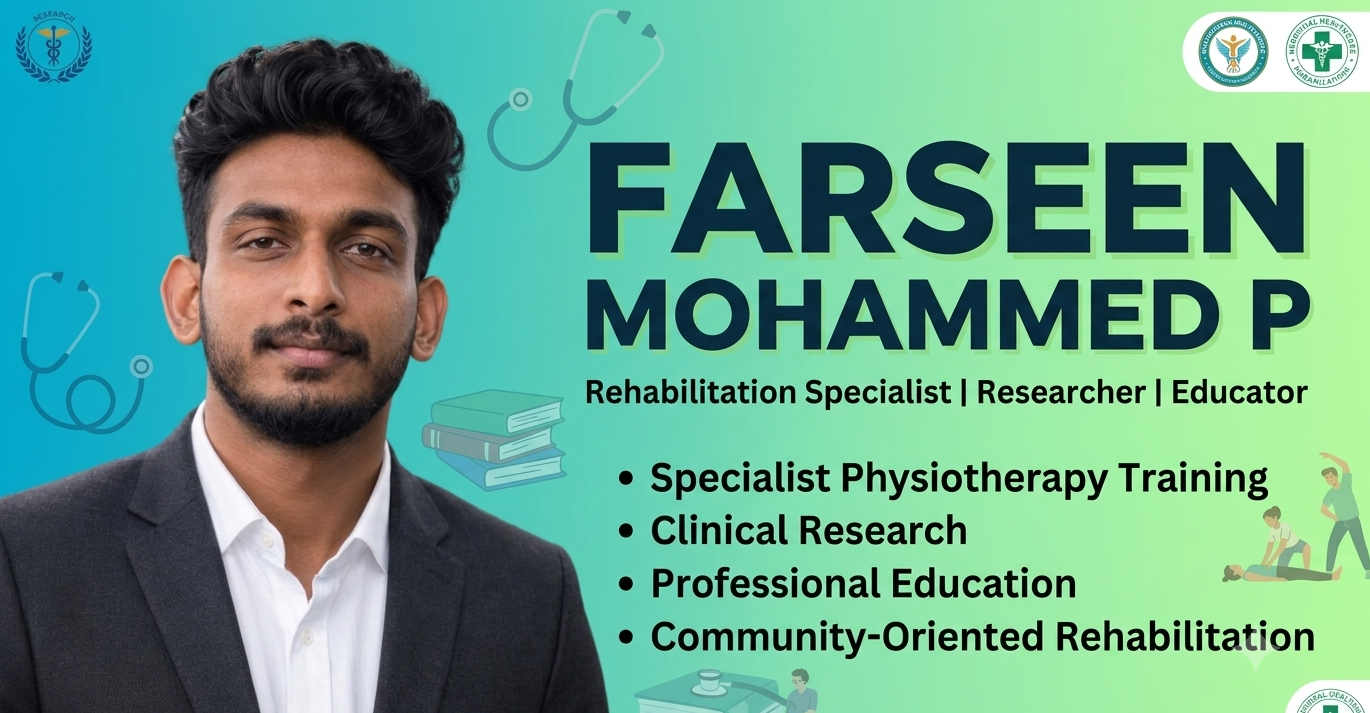

Malappuram, Kerala / Mangaluru, Karnataka: Physiotherapy extends beyond treatment delivered inside hospitals and rehabilitation centers. Recovery can continue after discharge through appropriate exercise, education, prevention strategies, functional training, and support for returning to everyday life. Farseen Mohammed P has developed professional interests that reflect this broader understanding of rehabilitation, combining specialist physiotherapy training with clinical research, professional education, and community-oriented rehabilitation.
His academic and clinical journey in neurosciences has given him exposure to patients with complex neurological conditions, while his research and professional activities have increasingly addressed questions surrounding functional recovery and rehabilitation beyond the immediate clinical setting.
Looking Beyond Hospital-Based Treatment
For many patients, rehabilitation does not end when formal hospital treatment finishes.
Individuals recovering from stroke, Parkinson’s disease, traumatic brain injury, or other neurological conditions may continue to experience mobility limitations, weakness, balance difficulties, reduced independence, or challenges returning to normal activities.
Physiotherapy can contribute to this stage of recovery through therapeutic exercise, functional training, education, prevention strategies, and appropriate follow-up.
Farseen’s professional interests reflect this broader rehabilitation perspective. His clinical specialization in neurosciences has exposed him to neurological rehabilitation, while his academic activities have explored functional outcomes and exercise-based approaches.
A Foundation in Neurorehabilitation
Farseen completed his Master of Physiotherapy in Neurosciences at Yenepoya Physiotherapy College, Yenepoya (Deemed to be University), Mangaluru.
During his postgraduate clinical training at Yenepoya Medical College Hospital, he gained experience with neurological conditions including stroke, Parkinson’s disease, traumatic brain injury, Guillain-Barré syndrome, and spinal cord disorders.
His training included approaches such as Neurodevelopmental Treatment, Motor Relearning Programme, and task-oriented training.
These approaches are relevant to rehabilitation because they emphasize functional movement, motor learning, and participation in meaningful activities.
Stroke Rehabilitation and Functional Independence
Stroke rehabilitation has been one of the most prominent areas of Farseen’s academic work.
His postgraduate dissertation examined the effect of eccentric versus concentric strengthening on functional mobility in subacute stroke patients.
The subject reflects an important rehabilitation objective: helping individuals regain functional capacity following neurological injury.
His continuing research interest in eccentric strengthening interventions has also led to systematic review work examining functional outcomes in adults after stroke.
By focusing on functional mobility and exercise-based rehabilitation, his academic work connects clinical intervention with the broader goal of helping patients achieve greater independence.
Parkinson’s Disease and Long-Term Rehabilitation
Parkinson’s disease is another condition requiring ongoing rehabilitation and long-term management.
Farseen’s involvement in a 2026 scoping review examining the timing of dopaminergic medication relative to physiotherapy delivery in adults with Parkinson’s disease demonstrates his interest in the relationship between medical management and rehabilitation.
The research highlights the importance of considering physiotherapy within the wider healthcare journey of people living with chronic neurological conditions.
For such patients, rehabilitation may involve ongoing exercise, movement strategies, functional training, education, and adaptation to changing needs.
Life After Discharge
An important part of Farseen’s professional engagement has involved rehabilitation after hospital discharge.
On 5 September 2026, he served as a resource person for a CME program for nursing professionals at St. Joseph’s Mission Hospital, Anchal, Kerala.
His session was titled “Life After Discharge: Physiotherapy-Guided Secondary Prevention and Community Reintegration.”
The topic reflects the importance of continuing rehabilitation after a patient leaves the hospital.
Secondary prevention and community reintegration can involve helping individuals maintain physical activity, manage functional limitations, reduce avoidable complications, and gradually return to social and everyday activities.
Sharing Knowledge With Healthcare Professionals
Professional education is another component of Farseen’s developing career.
His participation as a resource person demonstrates an interest in sharing rehabilitation knowledge with other healthcare professionals.
Working with nurses and other members of healthcare teams is particularly relevant in rehabilitation because recovery often requires coordinated care.
Patients may interact with physiotherapists, nurses, physicians, occupational therapists, caregivers, and other professionals during different stages of recovery.
Effective communication between these groups can support continuity of care.
Research Supporting Community Rehabilitation
Farseen’s research interests also connect with the broader concept of sustainable rehabilitation.
His work on therapeutic exercise, stroke recovery, Parkinson’s disease, cardiac rehabilitation, and metabolic health all involve questions related to function and health outcomes.
His systematic and scoping review activities aim to understand existing scientific evidence that can inform rehabilitation approaches.
This research-oriented perspective can contribute to better understanding of how physiotherapy interventions may be used not only during intensive clinical rehabilitation but also as part of longer-term health management.
Therapeutic Exercise as a Long-Term Strategy
Exercise is a recurring theme throughout Farseen’s academic and professional interests.
His research includes strengthening interventions in stroke rehabilitation, exercise-based cardiac rehabilitation, and exercise interventions related to metabolic health.
Therapeutic exercise can have an important role in rehabilitation because it may be adapted according to a person’s condition, functional capacity, goals, and stage of recovery.
His professional interests therefore extend beyond individual treatment sessions toward broader questions about exercise, function, prevention, and long-term health.
Community Reintegration and Functional Goals
Rehabilitation is ultimately connected to participation in everyday life.
For a person recovering from stroke, successful rehabilitation may involve more than improvements measured during a clinical assessment. It may also involve being able to walk safely, perform daily activities, communicate with others, return to family responsibilities, or participate in the community.
Similarly, people living with Parkinson’s disease or other chronic neurological conditions may need continuing strategies to remain active and independent.
Farseen’s clinical and academic interests in functional mobility and rehabilitation align with this wider perspective.
Multidisciplinary Understanding of Rehabilitation
Farseen’s clinical exposure also extends beyond neurological physiotherapy.
His postgraduate training included musculoskeletal and orthopaedic rehabilitation, post-surgical rehabilitation, manual therapy, therapeutic exercise, and integrative physiotherapy.
His research interests in cardiac and metabolic rehabilitation further expand his understanding of multidisciplinary healthcare.
This broad exposure can be valuable when considering rehabilitation as part of an individual’s overall health rather than as an isolated clinical service.
Nutrition and Health Education
Farseen’s professional background also includes a postgraduate diploma in nutrition and an ACE Health Coach certification.
These qualifications add another dimension to his interest in health promotion and rehabilitation.
While physiotherapy remains central to his professional identity, knowledge related to nutrition, exercise, and health coaching can contribute to a broader understanding of lifestyle and rehabilitation-related health considerations.
Continuing Professional Development
Farseen has continued to invest in professional education through workshops, certifications, conferences, research training, and academic activities.
His professional development includes training in Good Clinical Practice, systematic review and meta-analysis, neurological rehabilitation approaches, health science research, and therapeutic exercise.
Such continuing education reflects the importance of keeping rehabilitation practice connected with evolving evidence and professional knowledge.
A Growing Role in Rehabilitation Education
Farseen Mohammed P’s career demonstrates an expanding role that combines clinical physiotherapy, research, professional education, and community-oriented rehabilitation.
His work with neurological patients provides a foundation for understanding the challenges associated with long-term recovery, while his research interests explore interventions and evidence relevant to functional outcomes.
His participation as a CME resource person further demonstrates his involvement in professional knowledge sharing.
As physiotherapy continues to evolve toward evidence-based, patient-centered, and community-oriented models of care, professionals with clinical, research, and educational interests can contribute to this transition.
Farseen Mohammed P’s developing profile reflects this direction, bringing together neurophysiotherapy, therapeutic exercise, clinical research, professional education, and the broader goal of supporting patients not only during treatment but throughout their journey toward functional independence and community participation.